
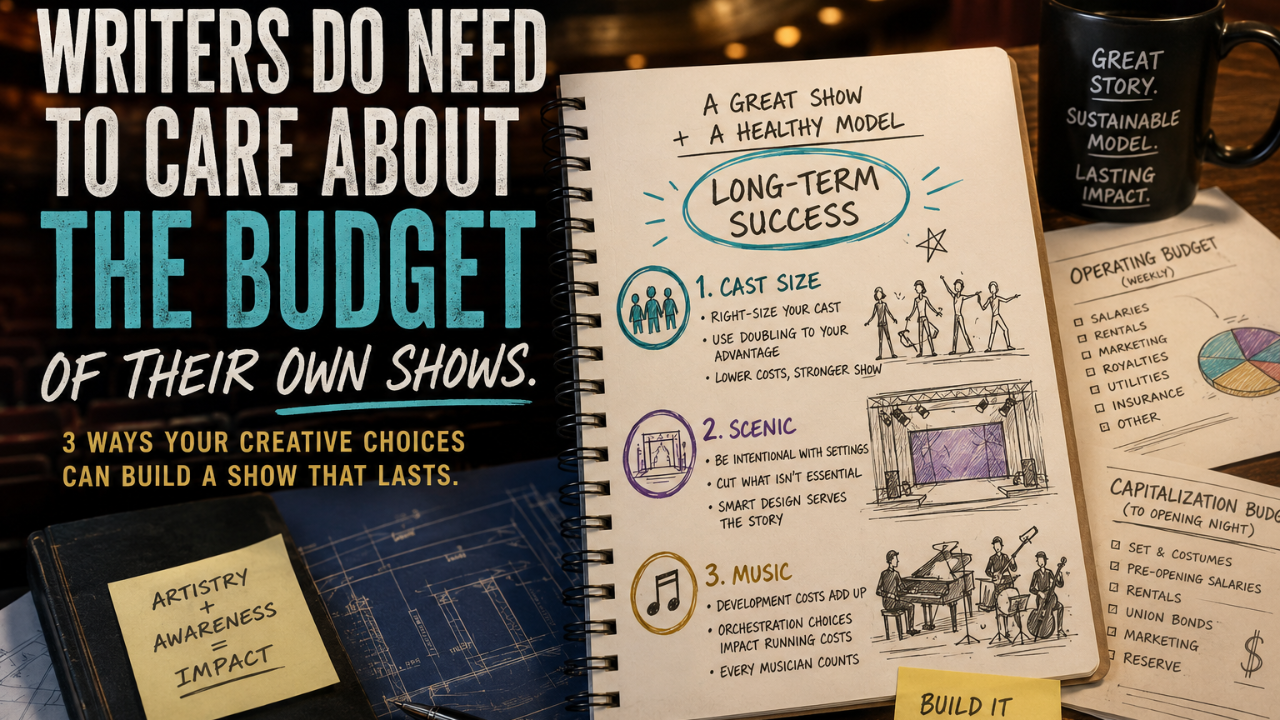
Why Writers Need to Care About Their Show’s Budget
Written by Producer & TMS Mentor, Jonathan Hogue
I remember how angry this one comment made me.
“This show is great… but it’s never going to work the way you’ve built it.”
It was in the early days of developing my first musical. I presented an industry reading that had a great response and generated some genuine commercial interest - until I started hearing this comment over and over.
It felt like such a slap in the face. Why couldn't people see the show for what I'd built it to be? Surely these people just don’t have the same vision I have. All I needed was a producer to fund my dream show exactly as I had written it, and it would sell like gangbusters.
I soon came to realize that they were right. I had built a show that was ultimately too difficult to produce.
And as I started digging into this, I realized a major truth:
Writers do need to care about the budget of their own shows.
The reality is, the commercial success of a show is only as good as the model that sustains it. If a show wants to be a long-term success, the originating production needs to be able to run long enough for it to have a cultural impact. Build a show that is too expensive to run, and you may face an early closing, which means a brand tainted by commercial struggle, less impact for awards potential and licensing, and ultimately a smaller window for people to experience it live.
Granted, building a healthy model for a show is a hugely complex puzzle that a savvy producer and general manager will know how to solve. But you, as the author, should also care about how this budget runs, because there are a few things you can do to ensure your show has the ability to become a long-running hit.
But first, a few things to clear up: when I talk about a budget, I am talking about two different types of budgets - a capitalization and an operating budget. The capitalization indicates the total cost to build your show and get it to opening night (inclusive of all design builds, salaries pre-opening, union bonds, space and equipment rentals, a healthy reserve, etc); the operating budget indicates your recurring expenses week over week (salaries, rentals, marketing spend, etc.). If your show’s gross potential - meaning roughly what the production can potentially earn weekly in ticket sales based on theatre size and average ticket price - isn’t high enough to meet your weekly “nut,” you’re either looking at majorly raising ticket prices or majorly cutting down on expenses. Bearing in mind: the higher your ticket prices go, the more likely you’ll be to need discounting, as at a certain point you’ll price out some of your core audience (unless you happen to be the hottest ticket in town).
Here are 3 places where a writer can support creating a sustainable model for their show through their own creative contributions.
Cast Size - Remember that “unworkable” show I mentioned at the beginning? It was largely unworkable because it was meant to be a small, scrappy off-Broadway musical comedy, but I built it with a cast of 12. After being told relentlessly that I needed to get the cast size down, I eventually found a tighter and sharper version of the show with 8 actors doubling roles. This doubling helped build a show with lower operating costs, and it also happened to enhance the comedy! Of course, musicals and plays with casts of 20+ still exist today, but they are almost non-existent in commercial off-Broadway shows because achieving a healthy gross potential that can surpass weekly expenses and have a hope to recoup its capitalization by the end of the run is incredibly difficult in theatres under 300 seats. Also - bear in mind that a cast of 12 really means closer to a cast of 16+ once understudies and swings are included!
Scenic - I’ve heard on more than one occasion about Broadway shows where, during development, whole scenes or scenic elements are cut and reworked purely because the scenic demands of getting the show to properly depict one specific location (that may not even be crucial to the plot) add up significantly. Especially for shows with more literal scenic locations rather than abstract ones, creative teams often have to really analyze whether certain locations or scenic elements are absolutely necessary for the success of the show, or if the limited budget can be spent elsewhere. In other cases, I’ve found that some shows succeed because they take a less literal approach to depicting a setting - even a stripped-back design can enhance the text in ways that a flashy set might distract from.
Music - If you’re writing a musical, this is another major one. Music costs can add up very quickly between music directors, orchestrators, arrangers, music copyists, and all the associate and assistant work that goes into creating and adapting a score, especially during development and previews. But beyond the upfront development expenses, orchestration choices also have a major impact on a show’s long-term operating budget, since every additional musician represents an ongoing weekly cost for the entire life of the production - including salary, pension and health contributions, rehearsal calls, and potential swings or subs. A lush orchestral sound may be artistically exciting, but it permanently raises the cost of running the show. Now granted, there are Broadway union minimums that dictate the baseline number of musicians required in certain theatres, so a show like Titanique, which ran off-Broadway with a small band, had to expand its orchestrations for its Broadway run at the St. James Theatre - but that doesn’t change the underlying reality that scale in the score directly shapes the show’s economics, and the difference between a 6-piece and a 16-piece band can dramatically alter whether a production can sustain itself long-term.
Ultimately, while producers may not always feel it’s necessary for the writer to be deeply involved in the show’s budgeting, there are almost always conversations around any show in development about reworking the script to support a healthier operating budget and capitalization without detracting from the storytelling goals of the piece. So when this happens to you, know that it’s not just a producer trying to turn your show into something it’s not - it’s a producer seeing the potential for your show to become a long-running hit, and looking to you to join in building the model for success together!
