
What the 2026 Tony Winners Reveal About Broadway Audiences
Written by TMS CEO Monica Hammond
Every year, TheaterMakers dissect the Tony Awards looking for clues.
Which shows won?
Which artists were recognized?
Which productions beat the odds?
But perhaps the most interesting question isn't who won.
It's why audiences connected with these stories in the first place.
Theater is often discussed as an art form, but Broadway is also a marketplace. Every season, dozens of productions compete for the same audience attention, the same discretionary spending, and the same cultural conversation.
The shows that rise to the top frequently reveal something deeper about what audiences are craving in a particular moment.
Looking at the 2026 Tony Award winners, several themes emerge—offering valuable lessons for TheaterMakers hoping to build audiences for their own work.
1. Audiences Want Escapism—But Not Empty Escapism
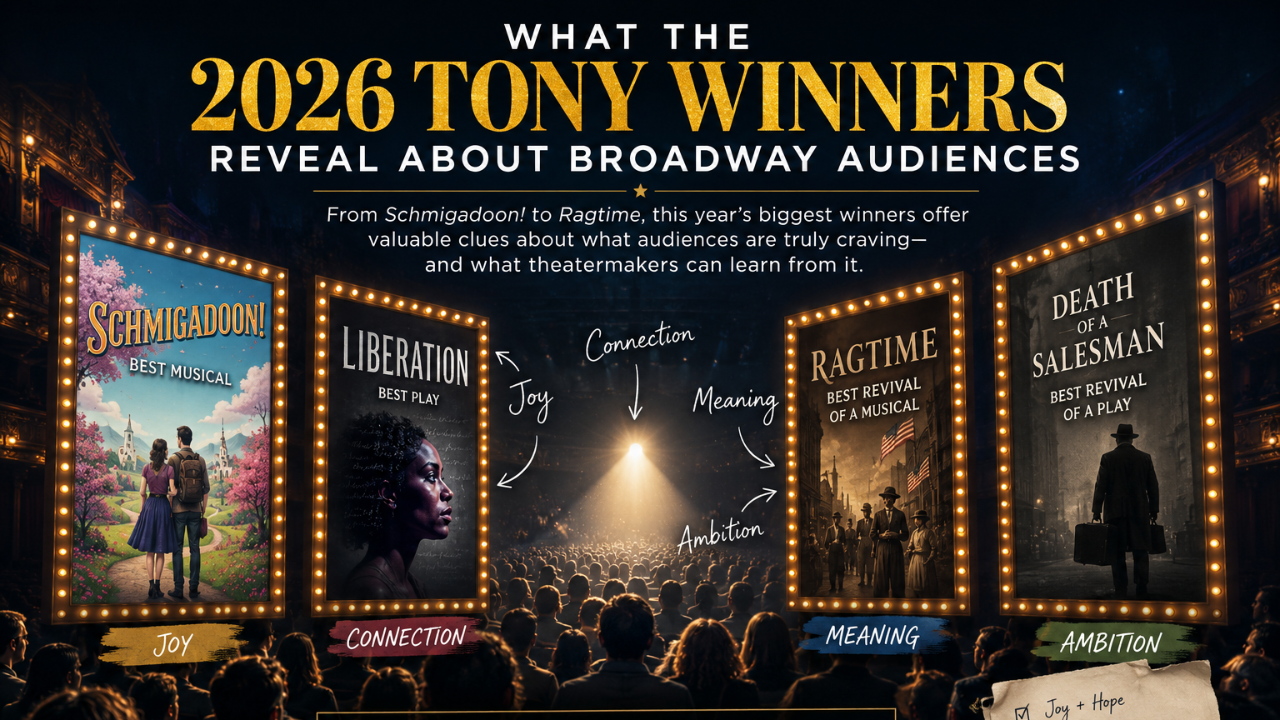
When Schmigadoon! took home the Tony Award for Best Musical, it wasn't just a victory for a beloved television adaptation.
It was a reminder that audiences continue to crave joy.
In a cultural landscape dominated by uncertainty, political division, economic anxiety, and digital overload, Schmigadoon! offers something increasingly rare: optimism.
But what's important is that it isn't shallow optimism.
The show combines nostalgia, humor, self-awareness, and genuine emotional stakes. It allows audiences to escape reality while still reflecting on it.
For TheaterMakers, this presents an important lesson:
Audiences don't necessarily want to avoid difficult subjects. They want hope alongside them.
Many emerging writers feel pressure to tackle serious themes. That's admirable. But successful storytelling often balances darkness with delight, tension with release, and challenge with entertainment.
The audience isn't simply buying a ticket to think.
They're buying a ticket to feel.
2. Audiences Are Craving Authentic Human Connection
Best Play winner Liberation explores questions of identity, relationships, and personal freedom through deeply human storytelling.
Its success reflects a broader trend we've seen across theater, film, television, and publishing: audiences are increasingly drawn to stories that feel emotionally honest.
In an age of algorithms, artificial intelligence, curated social media feeds, and constant digital noise, authenticity has become a premium commodity.
People are hungry for stories that help them make sense of their own lives.
Not because they offer answers.
Because they ask meaningful questions.
The takeaway for playwrights is simple:
Don't chase trends.
Don't try to engineer virality.
Tell the most honest version of the story only you can tell.
Authenticity is becoming one of the most valuable currencies in modern storytelling.
3. Audiences Still Love Big, Sweeping Stories
The revival of Ragtime winning Best Revival of a Musical is particularly revealing.
For years, there has been speculation that audiences have shorter attention spans, want smaller stories, and are less interested in ambitious theatrical experiences.
Yet Ragtime reminds us that audiences still respond to epic storytelling.
The show tackles immigration, race, class, family, and the American Dream itself.
It's expansive.
It's emotional.
It's unapologetically ambitious.
The success of Ragtime suggests that audiences aren't rejecting complexity.
They're rejecting complexity without clarity.
People will gladly invest three hours in a story if they understand what's at stake and why it matters.
For TheaterMakers, this is encouraging.
You don't need to shrink your vision.
You need to communicate it clearly.
4. Classic Stories Continue to Speak to Modern Problems
Few plays are as frequently revived as Death of a Salesman.
And yet every generation finds something new in it.
Its Tony-winning revival demonstrates that audiences continue to connect with stories about ambition, identity, success, and personal worth.
Why?
Because those themes are timeless.
The specifics may change.
The pressure to succeed remains.
The fear of falling behind remains.
The struggle to define our value remains.
The best revivals don't simply preserve old work.
They reveal why that work matters today.
This offers another lesson for contemporary writers.
When creating new work, don't focus solely on what's current.
Focus on what's enduring.
The stories that last are often rooted in universal human experiences.
What TheaterMakers Should Take Away
If the 2026 Tony winners reveal anything, it's that audiences are searching for stories that help them navigate an increasingly complicated world.
They want joy.
They want honesty.
They want meaning.
They want connection.
And perhaps most importantly, they want experiences that make them feel more human.
As TheaterMakers, it's easy to become consumed by production logistics, industry gatekeepers, development opportunities, and awards recognition.
But the most successful shows begin with a simpler question:
What does the audience need right now?
The productions that answer that question effectively don't just win awards.
They build communities.
They create movements.
They change lives.
The Tony Awards recognize excellence in theater.
But beneath every trophy is a deeper story: a story about audiences, what they're seeking, and why certain stories break through.
For TheaterMakers paying attention, that's where the real lesson lies.
