
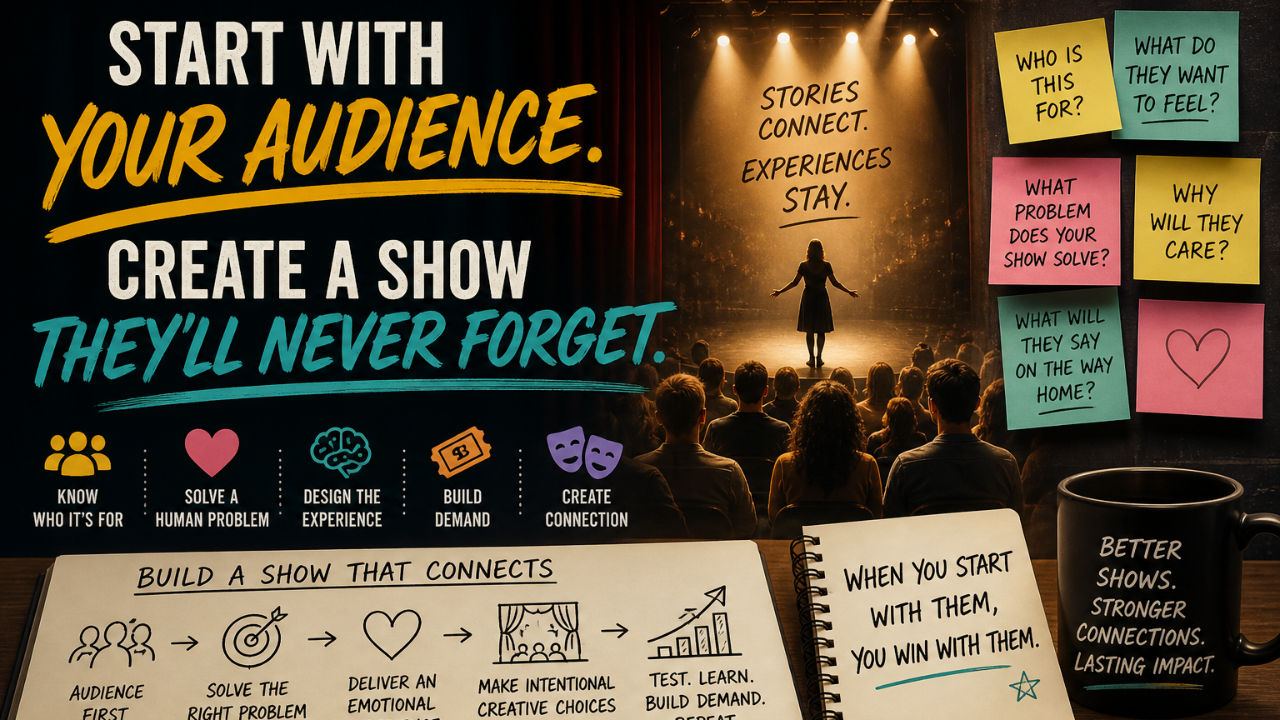
Start With the Audience: How to Reverse-Engineer a Hit Show
Written by TMS CEO Monica Hammond
Most playwrights and theater creators start in the same place:
An idea. A story. A character they can’t stop thinking about.
And while that’s an awesome way to create art… it’s not always the most effective way to create a successful show.
Because here’s the truth most people won’t say out loud:
A great show doesn’t just express something.
A great show connects with someone.
And that “someone” — your audience — is where your process should begin.
Think about it...in business, the most successful companies don’t start with the product.
They start with a clearly defined audience that has a problem they are solving.
Only then do they build the product to solve that problem.
That’s why their offers feel irresistible.
Now imagine applying that same thinking to creating a new show.
Instead of sitting down at your desk and asking yourself:
“What story do I want to tell?”
Try asking:
“Who is this for?”
Get specific:
- Is it millennial women navigating identity and ambition?
- Is it theater-loving tourists looking for a high-energy night out?
- Is it parents seeking meaningful experiences with their teens?
- Is it fans of true crime, romance, nostalgia, or spectacle?
The clearer the audience, the clearer your path to success.
People don’t buy tickets because of plot.
They buy because of how they expect to feel.
Whether you're starting a new project or applying these questions to your current work, I encourage you to ask:
- What emotional experience am I delivering?
- Escape?
- Catharsis?
- Laughter?
- Nostalgia?
- Shock?
- What will they say on the way home?
- “That was hilarious.”
- “I feel seen.”
Your show isn’t just a story.
It’s an emotional product.
The next step is to identify the problem you're solving.
This is where it gets interesting.
Yes — theater solves problems.
Not in the traditional sense… but in a deeply human one.
Your show might help solve:
- Boredom → by delivering a thrilling night out
- Loneliness → by creating shared emotional connection
- Ableism → by creating an inclusive experience
- Burnout → by offering escape and joy
When you understand the “problem,” your show becomes more than art.
It becomes valuable.
Now — and only now — do you start to structure and write your next show by making intentional choices, like:
- Story & Themes → What resonates with this audience?
- Tone & Style → Comedy? Drama? Interactive? Spectacle?
- Casting & Characters → Who will they connect with?
- Staging & Format → Traditional? Immersive? Intimate?
- Run Time & Pacing → What keeps this audience engaged?
Every decision becomes sharper.
Because it’s anchored in who you’re serving.
And one of the biggest advantages of this approach?
You can test it early and start building an audience long before opening night.
- Host a reading for your target audience
- Share content or scenes online
- Build an email list around the concept
- Run a small workshop production
Watch what resonates.
Listen to what people say.
Track what they share.
Implement that feedback into your next draft.
Now, let’s be clear — the goal isn't to kill creativity.
The goal is to sharpen it.
You’re still telling stories.
You’re still creating art.
But now you’re doing it with intention.
With clarity.
With a built-in audience.
So, before you write your next scene, outline your next act, or pitch your next idea…
Ask yourself this:
Who is this for — and why will they care?
Because when you start there…you don’t just create a show.
You create demand.
