
A Long Essay on a Short Play
Written by TMS Director of Creative Development & Mentor, Eric Webb
Hello, TheaterMakers!
I’ve expounded in this space before about my adoration of the 10-minute play and how it can be an indispensable exercise for emerging playwrights as well as an incredibly useful tool for networking and building your resume (seemingly every theater has a 10-minute play festival, and it’s a great way to get in the door of places you might want to pitch your other work to eventually!).
That adoration has not changed.
However, I just attended a (relatively well-known) 10-minute play festival and I was shocked to see the number of “plays” on the stage that simply… weren’t plays.
They were 10 minutes long.
They were performed in a theater.
But they were not plays.
They were sketches, prologues, shaggy dog stories leading to a groan-inducing pun.
So how do we, as writers, recognize the difference and actually write a play?
I’m so glad you asked…
A sketch typically begins with a funny idea or comic situation.
"What if god was a baby?"
"What if Shakespeare wrote text messages?"
The humor comes from exploring the premise. You escalate the situation, repeating variations on the central joke until it reaches a satisfying punchline or absurd conclusion. Characters don’t typically change or have deeper wants or emotional arcs. The sketch succeeds if it consistently delivers laughs.
That's it.
That’s not a play.
A joke is even more streamlined.
Every element serves a single purpose: delivering the punchline. Once the punchline is delivered, the joke is over. There may have been a beginning, middle, and end in structuring the joke… but nothing changed.
Not a play.
SO WHAT IS A FREAKING 10-MINUTE PLAY, THEN?
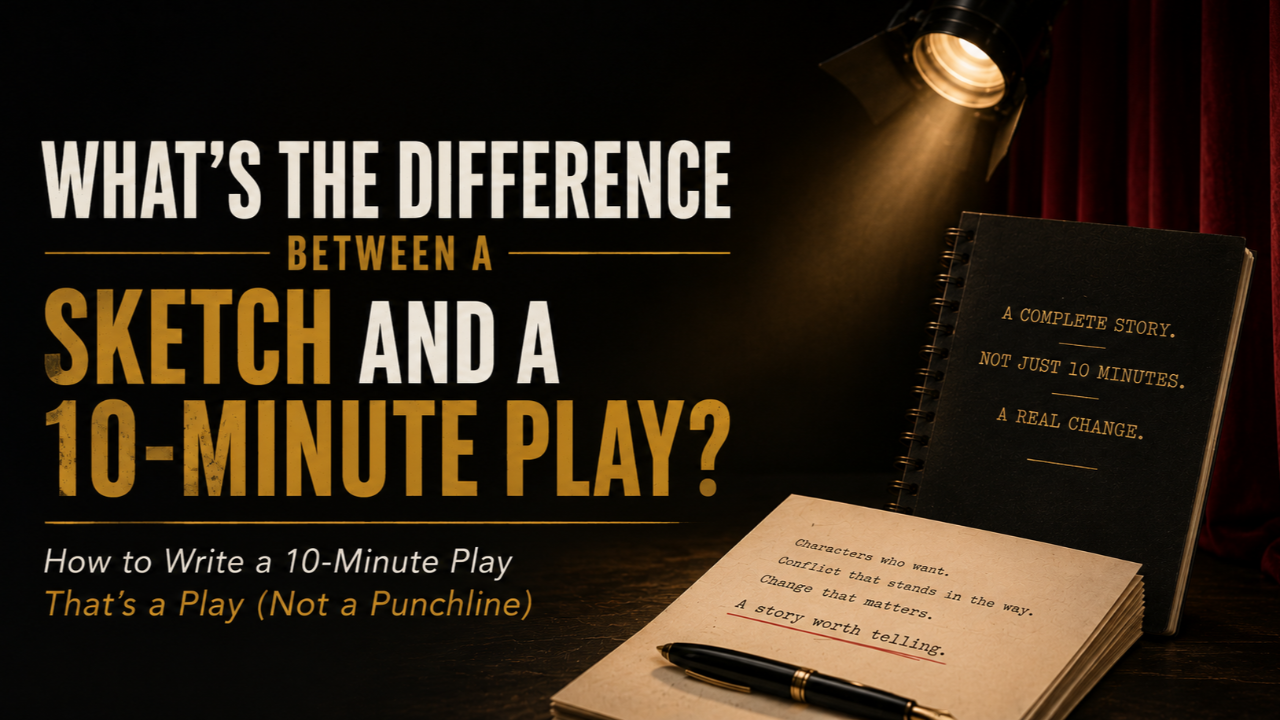
A 10-minute play must accomplish everything a full-length play does—just with incredible economy.
It needs:
- Characters who want something.
- Conflict that stands in the way.
- Rising action.
- Discovery or reversal.
- A climax.
- A meaningful resolution.
In other words, it tells a complete story with a beginning, a middle, and an end.
One of the biggest mistakes beginning playwrights make is confusing "short" with "simple."
The time limit doesn't change the fundamental nature of dramatic storytelling - it just demands greater precision.
A 10-minute play stands alone. It isn't a condensed first act. It isn't the opening scene of a larger work. It isn't an extended monologue with a clever ending.
It's a complete dramatic experience told through compression.
Because the format is short, some writers assume they need some sort of gimmick to stand out: a clever twist or surprise ending...
Those can certainly work (and believe me, I’ve written my fair share of these kinds of plays).
But audiences rarely remember a play solely because it fooled them.
They remember plays that made them feel something.
Even in ten minutes, characters can experience loss, hope, forgiveness, disappointment, joy, fear, or revelation. A genuine emotional shift—even a subtle one—often creates a more satisfying ending than a final punchline.
That's another major distinction from sketches.
A sketch aims for laughter.
A play aims for transformation.
Sometimes that transformation is funny. Sometimes it's heartbreaking. Sometimes it's both.
So yes, please… write all of the 10-minute plays! But remember…
The goal isn't to make something small.
The goal is to make something complete and transformative.
That’s a play.
